A short, light, engineering-oriented guide to Battery Management Systems – when they save the day, and when they simply add weight, cost, and headache.
| A modern battery is not just a box full of energy. It is more like a small power plant: powerful, sensitive, expensive – and sometimes with a personality of its own. The BMS is the responsible adult in the room: the bodyguard, the doctor, the traffic officer, and sometimes the one who pulls the emergency brake before the drama begins. |
What Does a BMS Actually Do?
A BMS is, quite simply, a “Battery Management System”. Its main role is easy to define and hard to execute:
to keep the battery inside the safe “playing field” defined by the system designer.
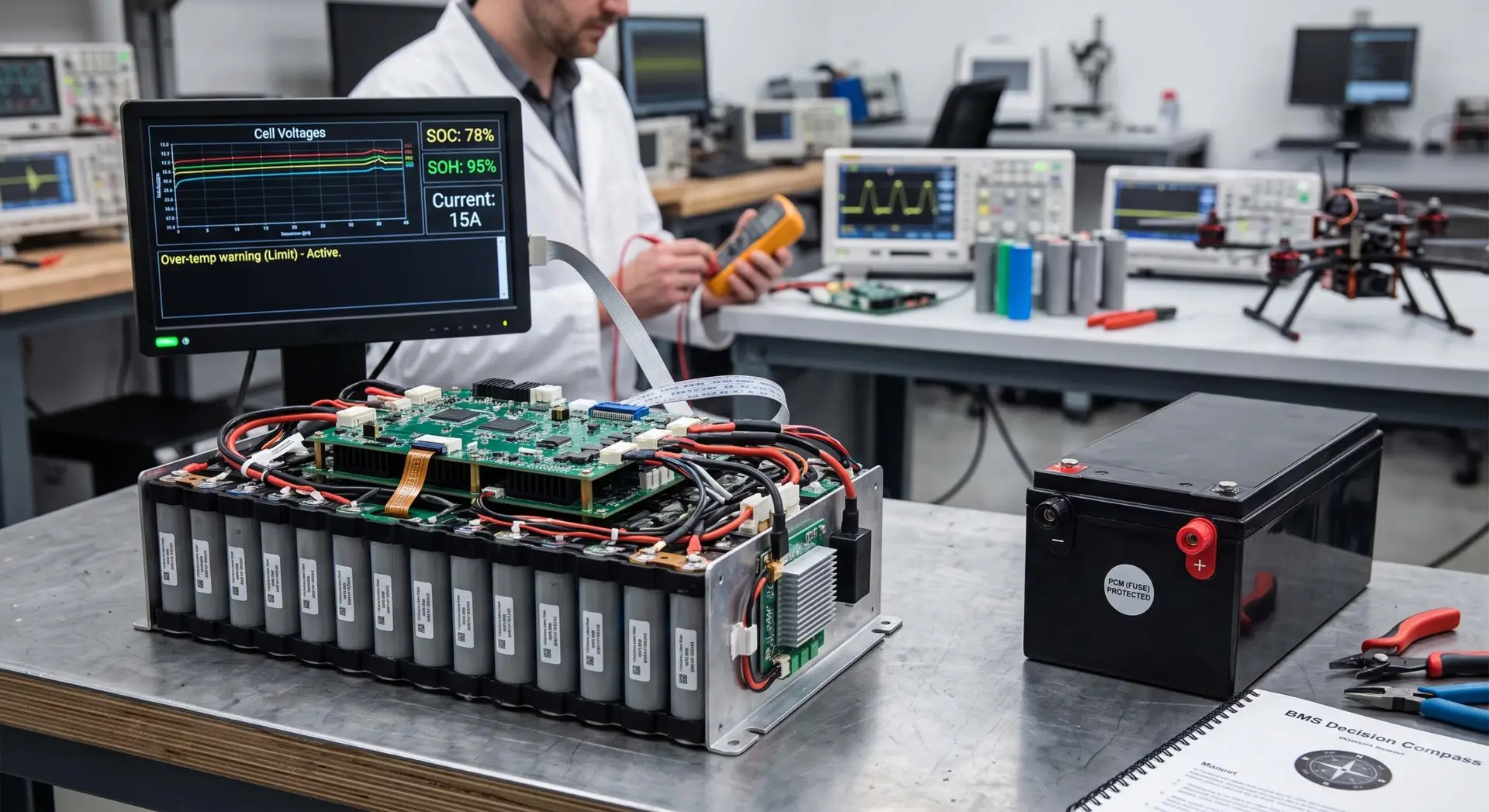
It measures cell voltages, pack voltage, charge and discharge currents, temperatures, SOC (State of Charge), and SOH (State of Health) (based on a health-estimation algorithm). When everything is fine, it is almost invisible. Like a good guard at the gate, its best work is the kind nobody notices. But when the battery exceeds its limits, the BMS warns, limits, or stops operation.
It is important to remember: a BMS is only one possible way to protect a Li-Ion battery pack. It is not the only option.
It is often useful to have one, but in some cases, it may also interfere with system performance.
Why Is It Worth Having?
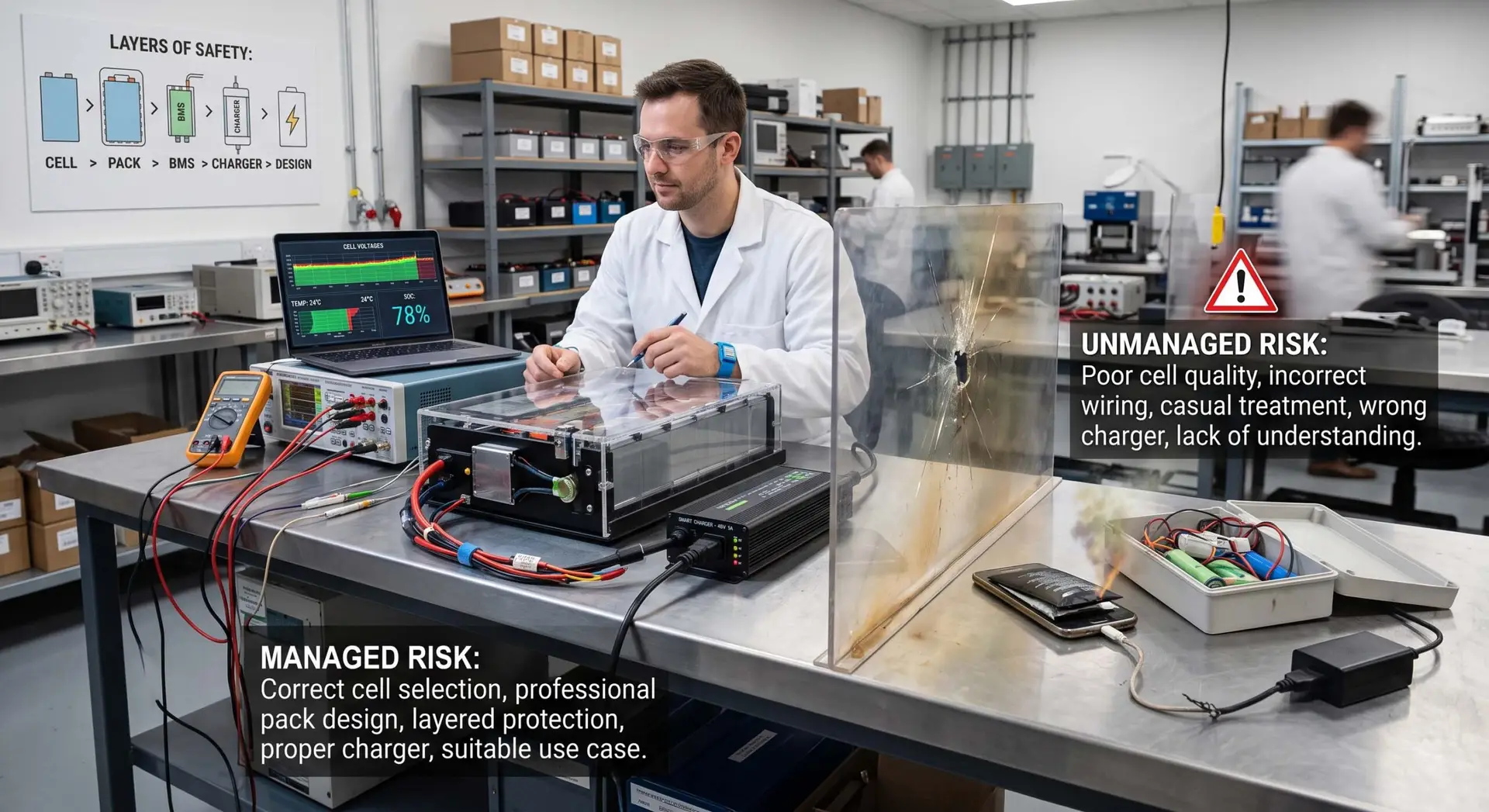
Safety. Lithium batteries are excellent energy sources, but they are not very forgiving. If you do not fully trust the end user, a battery with communication capability can be very useful: it allows the battery to “talk” with the system it powers and helps prevent operation outside the allowed boundaries.
System protection. The BMS allows you to define warning and protection parameters that match your specific system. In practice, it can protect not only the battery, but also the equipment powered by it.
Communication and diagnostics. Through CAN, SMBus, UART, or RS485, the system can receive voltage, current, temperature, SOC, operating status, and fault logs. When a problem occurs, the battery feels less like a “black box with a mood” and more like a system that can explain itself.
Sales value. A managed battery suggests a managed product. And let us be honest: if the competitor has battery communication and diagnostics, it will probably come up in the discussion.
And What Is the Price?
Like any bodyguard, a BMS is not free. If the application has strict size and weight requirements, an off-the-shelf product may not fit, and a custom system may be required. Beyond that, a BMS brings the familiar costs of development: time, NRE and RE cost, added validation, performance compromises, extra size and weight, and the reality that software- and algorithm-based systems tend to require updates over the years.
A poorly matched BMS can become a very polite troublemaker. It may disconnect too early, reject legitimate current pulses, prevent full charging, drain the pack during storage, or report faults that are not really system faults. A BMS is like a suit of armor: extremely useful, but only if it fits.
Not Every Fence Is a Full BMS
Between “only a fuse” and “a smart BMS with communication, logs, algorithms, and software updates,” there are useful middle options. A PCM (Protection Circuit Module) is a simple protection circuit (typically designed to protect the Battery) against overcharge, over-discharge, and short circuit, and, in most cases, includes internal balancing. In many small or medium packs, this may be enough. It is a gatekeeper, not a system manager.
Other applications may rely on fuses, thermal cutoffs, smart chargers, mechanical disconnects, external monitoring, or strict operating procedures. No BMS does not mean no protection. It only means the fence is built differently.
When Yes, and When Maybe Not?
In most rechargeable lithium battery packs, a BMS is not a decoration; it is a central component. The stronger, more expensive, more critical, or more unattended the battery is, the more it deserves a good BMS. This is especially true in medical, military, industrial, robotic, large UAVs, electric vehicle, and energy-storage applications.
On the other hand, not every application requires a full BMS. A very professional operated system, single lithium cell with built-in protection, a primary non-rechargeable battery, or an unusual pulse-power system may justify different protection.
Quick Decision Compass
| Typical Signs | Direction |
| An expensive ground system — battery cost >$1,000 | Yes |
| An expensive aerial system | Probably Yes, but BMS not on main power line. Telemetry only |
| Inexperienced end user; unattended operation; must tolerate misuse | Yes. No debate. |
| High voltage, above 64 V | Strongly recommended |
| The customer used the word “communication” | Probably yes, Otherwise, you may build a partial BMS under another name |
| You need to receive on-line accurate information regarding battery status (SOC etc.) / Manned aviation application | Yes |
| System has proven external protections and clear operating procedures | Not essential |
| Low-cost and high-reliability system with passive protection | Not necessarily |
| Very high-reliability systems, one operation scenario. | Probably Not. |
How to Start?
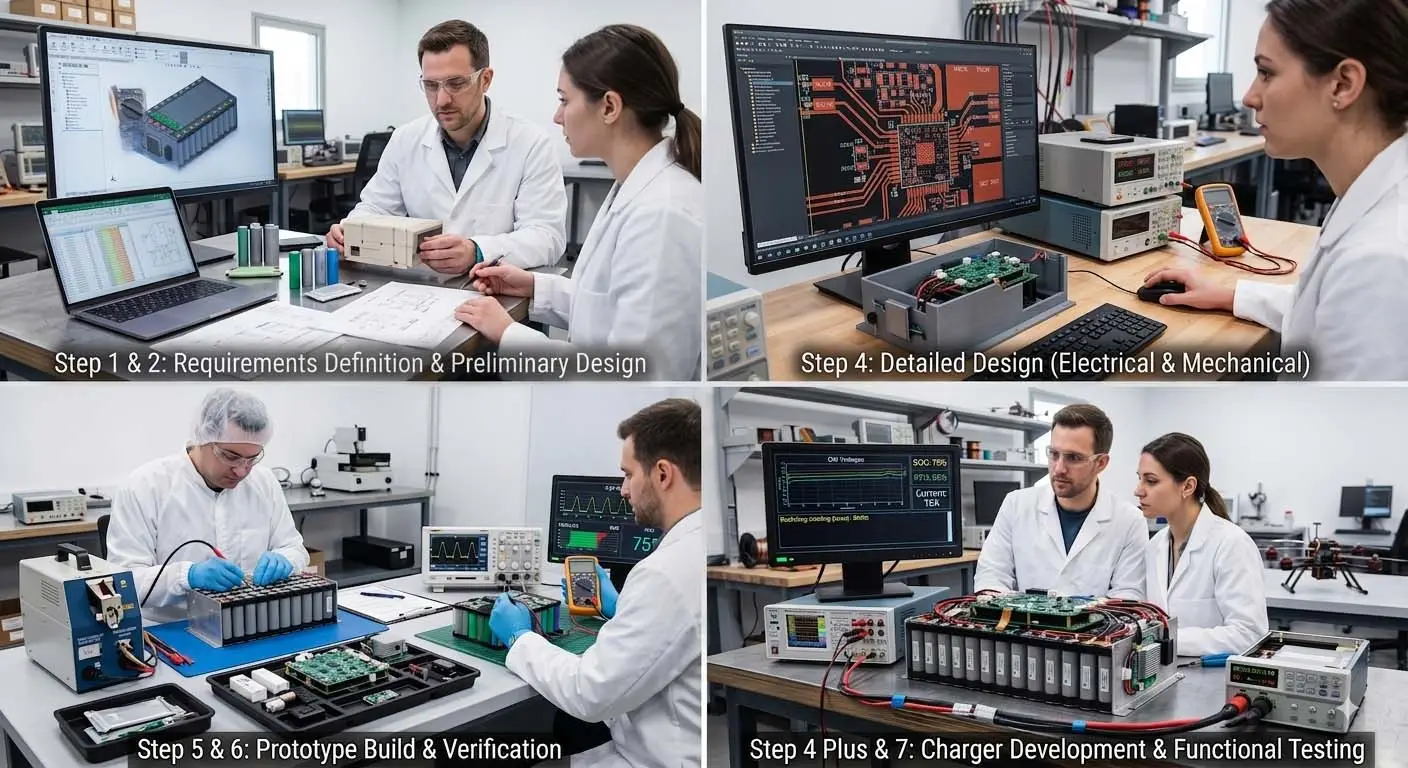
Unlike a simple PCM, a BMS project should start with the system requirements: required voltage and power, pulse currents and duration, host-system identification, warning and failure definitions, permanent-failure logic, temperature-based limits, Charger communication, thermal management system, or main controller.
It is important to remember that a BMS will not solve every system problem. It is not a substitute for proper cell selection or a good application-specific design. It is more like a solid, well-planned security system: highly valuable when designed correctly, but not a replacement for building the house properly in the first place.
Author’s note: The author is an engineer who has developed more than a handful of Battery systems over the years; and has seen how good, effective system can drift into several rounds of software updates, requirement changes, and “just one more revision” loops.