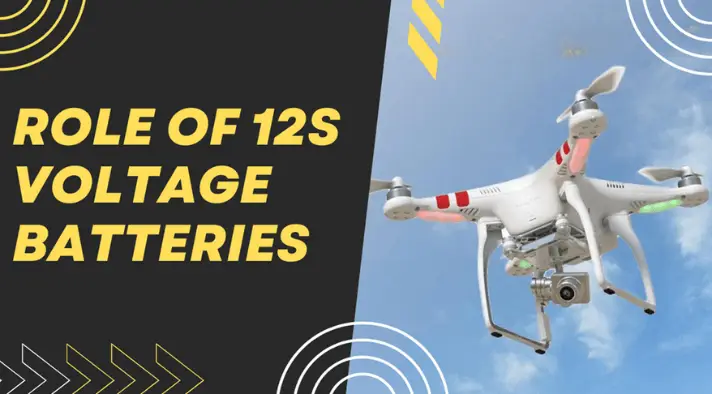
Introduction: Lightweight 12S Battery
Drones, or Unmanned Aerial Vehicles (UAVs), require batteries – as lightweight as possible, yet powerful – to ensure optimal performance and longer flight times.
The need for lightweight batteries is crucial, as the weight of the battery significantly impacts the drone’s payload capacity, maneuverability, and energy efficiency.
Moreover, the battery & it’s designed & electronics will also affect the end user’s ability to use the battery’s full potential.
Lightweight 12S Battery
Over the years, Amicell – Amit Industries Ltd designed numerous batteries for UAVs – from Li-Ion 12S batteries to LiPo 6S (Pouch).
Most of them with very strict demands for weight & volume.
Below, we’ll show the basic guidelines to achieve the best battery designs for your drone. We will use, as an example, a typical Battery designed in our factory – Li-Ion 12S 30Ah.
12S Battery Voltage: The Complete Chart
A 12S battery has 12 lithium cells connected in series. For Li-Ion and LiPo chemistries, a 12S pack has a nominal voltage of 44.4V, reaches 50.4V fully charged (4.2V per cell), and should not be discharged below 36.0V (3.0V per cell).
12S Voltage by Chemistry
| Chemistry | Per Cell (Nominal) | 12S Nominal | 12S Fully Charged | 12S Storage | 12S Minimum Safe |
|---|---|---|---|---|---|
| 12S Li-Ion | 3.6-3.7V | 43.2-44.4V | 50.4V (4.2V/cell) | ~46.2V (3.85V/cell) | 36.0V (3.0V/cell) |
| 12S LiPo | 3.7V | 44.4V | 50.4V (4.2V/cell) | ~45.6V (3.8V/cell) | 36.0V (3.0V/cell) |
| 12S LiFePO4 | 3.2V | 38.4V | 43.8V (3.65V/cell) | ~38.4V (3.2V/cell) | 30.0V (2.5V/cell) |
Values are per-cell limits multiplied by 12. Always follow the specific cell datasheet and BMS settings of your pack.
12S Li-Ion / LiPo Voltage vs. State of Charge
Use this chart to estimate remaining capacity from a resting pack voltage (no load, after a few minutes of rest):
| State of Charge | Per Cell (Resting) | 12S Pack Voltage |
|---|---|---|
| 100% | 4.20V | 50.4V |
| 90% | 4.11V | 49.3V |
| 80% | 4.02V | 48.2V |
| 70% | 3.95V | 47.4V |
| 60% | 3.89V | 46.7V |
| 50% | 3.84V | 46.1V |
| 40% | 3.79V | 45.5V |
| 30% | 3.75V | 45.0V |
| 20% | 3.70V | 44.4V |
| 10% | 3.62V | 43.4V |
| 0% (cutoff) | 3.00-3.30V | 36.0-39.6V |
Resting open-circuit voltages for typical Li-Ion/LiPo chemistry. Under load, voltage sags below these values; readings during flight or discharge will be lower than the true state of charge suggests.
Why Voltage Matters in a Lightweight Drone Battery
In a 12S drone battery, voltage is a live indicator of both remaining energy and battery health. Three practical rules from our pack designs:
Land before 20%. Flying a 12S pack below 44.4V (3.7V per cell under no load) accelerates cell aging and risks the BMS cutting power at the worst possible moment.
Store at 45.6-46.2V. Leaving a 12S battery fully charged at 50.4V between missions is the fastest way to shorten its calendar life. For storage of more than a few days, discharge to about 3.8-3.85V per cell.
Watch the spread, not just the total. A healthy 12S pack keeps all 12 cells within about 30-50mV of each other. A growing gap between the highest and lowest cell is the earliest warning of a failing pack, long before total voltage shows a problem. This is exactly what the AMICELL BMS monitors and balances continuously.
12S Battery Voltage: FAQ
What voltage is a 12S battery?
A 12S Li-Ion or LiPo battery is 44.4V nominal. It measures 50.4V fully charged
and about 36.0V at the safe discharge limit. A 12S LiFePO4 pack is lower:
38.4V nominal and 43.8V fully charged.
What voltage is a fully charged 12S LiPo?
50.4V, which is 4.2V per cell across 12 cells in series. Charging above this
level is unsafe and will damage the cells.
At what voltage should I land a 12S drone?
Plan to land at around 44.4V under no load (about 20% remaining). In flight,
expect readings 1-2V lower under load. Never let the pack fall below 36.0V.
What is the storage voltage for a 12S battery?
About 45.6-46.2V (3.8-3.85V per cell). Store packs at this level whenever they
will sit unused for more than a few days.
Be as accurate as possible when it comes to system requirements.
- Voltage range: the higher the voltage, the lower the current, and the wiring is thinner. It used to be more 6S & 7S LiPo batteries. Today a lot of UAVs are using Li-Ion 12S battery and above. 12S Voltage – This 12S battery has a max voltage of 50.4V for 4.2V cells & up to 51.6V for high Energy density batteries.
On the other hand, the charging system and balancing become more complex, and so will the optional Battery Management System (see paragraph 3d). - Discharge profile: In most Li-Ion battery technologies, Higher Energy density comes with lower discharge power. So, taking a high safety factor will make the designer choose a heavier battery, thicker wiring, and a more complex connector.
For example: there are online 40C LiPo Batteries, but for a 12S LiPo battery with a capacity of 30Ah, that means your system requires ~50 kW. Not a lot of applications need that high power in a battery that weighs only ~7 kg, so if your system requires less, you will receive a lighter battery.
Determine target weight.
The easiest thing is to say – I want the minimum weight. The problem is that “minimum weight” may come with a high price and lower reliability.
If we look at our case study:
Li-Ion Polymer 12S 30Ah (H320Wh/Kg series) Minimum weight with minimum casing: ~4.3 kg
Li-Ion 12S 30Ah Minimum weight with minimum casing: ~5.2 kg
The weight of the LiPo 12S battery can be 17% lower than the Li-Ion 12S. But there will be a price in cycles and in price.
Determine the battery’s maximum dimensions.
The easier it is to assemble, the easier it will be to reduce weight! Batteries with “Box” shape are usually simple to assemble and require less wiring, less tooling,g and less structure/casing.
When it comes to dimensions, there are advantages to Li-Ion over Li-Ion Polymer Batteries. To start, Li-Ion has lower energy density but higher volume density.
On the other hand, one of the key disadvantages of Li-Ion is that, for now, there are only two popular cell dimensions: 18650, 21700. That means (1) batteries that are too narrow (less than 19mm) practically don’t have a Li-Ion option, and (2) if the battery was not designed in parallel with the UAV itself, it will probably not have max volume efficiency.
Decide the level of safety & Telemetry will hold. Some options:
- No Internal safety – No Fuses on main power line. No safety circuits. Telemetry – Battery Voltage only.
Safety only while charging via the Discharge and Balance harnesses – connection to external safety circuits with over-charge protection. This is the level of safety received in most UAV batteries purchased online. - Fuses on main power line and on Balance lines. Telemetry – Battery Voltage only.
Safety against over-charging and external short-circuits. Connecting the Discharge and Balance harnesses to safety circuits with over-charge protection. - Fuses on main power line and on Balance lines, PCM on charging line only. Telemetry – Battery Voltage only.
Safety against over-charging and external short-circuits. The PCM supplies over-charge protection and low-current internal balancing so the end-user can use different chargers. - BMS system – Full Telemetry via coTelemetryon – SMBus / I2C / CAN, etc.
All safety decisions – according to algorithm.
Here, “the sky is the limit.” The communication system in the battery will be able to send online data regarding battery status. The operator will be the one deciding what to do.
The “heart” of this B” S sys “em is based on microchips of companies like TI, and there are microchips suitable for Li-Ion batteries of 12S and above.
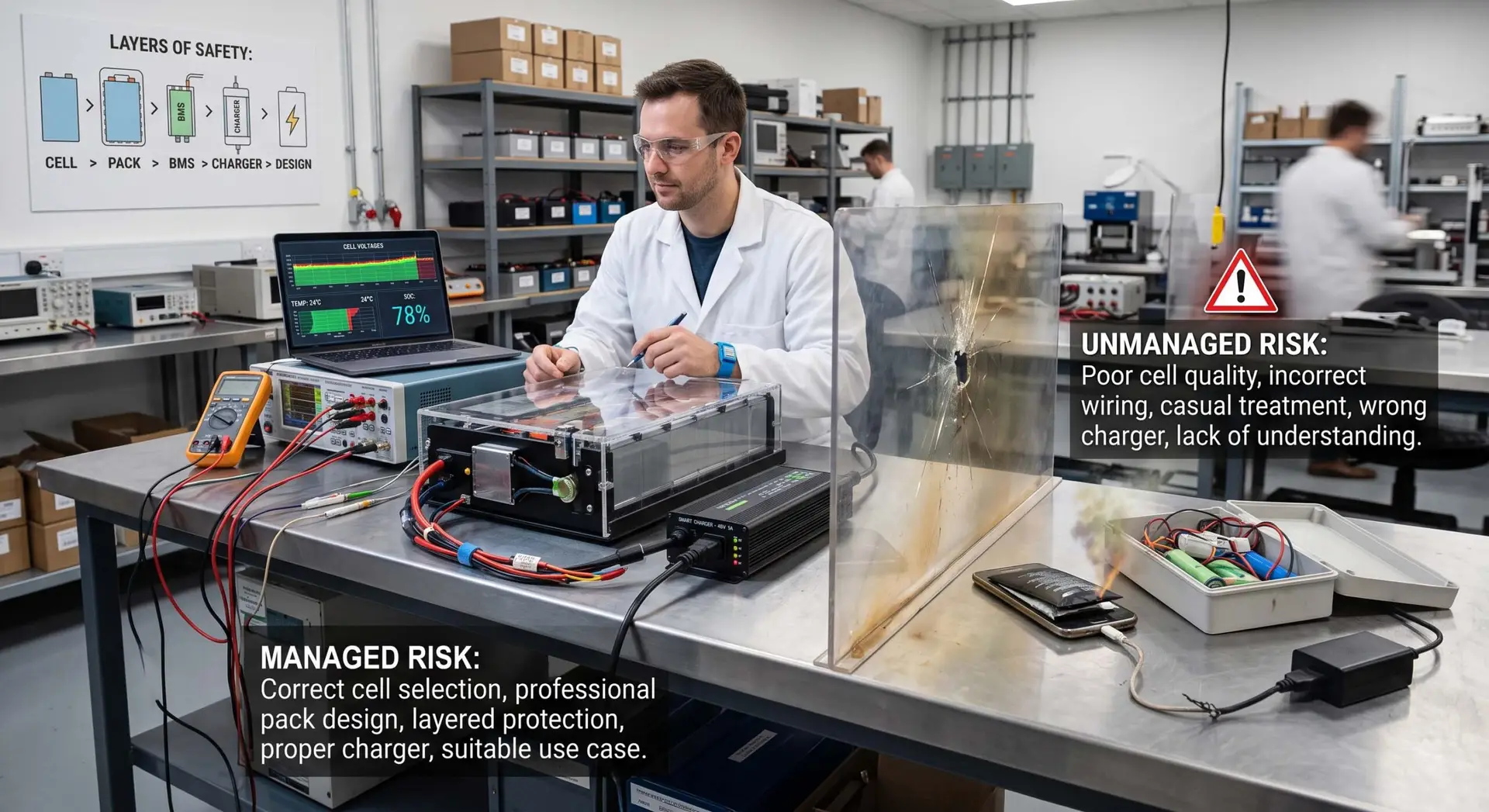
The thing to remember – The higher the safety, the more complex the battery becomes, and so will its design process and the need for maintenance.
It is not uncommon that, while developing a prototype, safety features are kept to a minimum first to prove the feasibility of the solution. In contrast, the BMS is developed in parallel.
Identify key performance parameters.
In other words – In case of a dilemma, what will be more important – energy density (& weight) / Power density / Lifecycle / Price
Casing
From the most basic (heat-shrinkable sleeve) to the most unique (3D Kevlar).
There are 4 reasons for casing of batteries:
- Safety – reducing risk of tampering with the battery, basic safety against drops, preventing mechanical load on electrical components & wiring, etc.
- Larger & heavier batteries need casing to prevent internal mechanical stress on the cells and on electrical connections. For example: a 12S Li-Ion battery with a capacity of 30Ah will weigh ~5 kg and assembled for 72 cells. These cells can be assembled in a narrow formation that fits a UAV fuselage, with a length that can exceed 60cm. This narrow, long battery will need casing to prevent it from deforming under its own weight.
- Making the product proof against mistakes. The battery dimensions will be uniform. The end-user cannot insert or use it in an unintended manner. Easier to verify correct insertion of connectors.
- Commercial – The product will look much better. Indications of battery status are visible. It is harder to copy or buy elsewhere.
However, the casing will also add NRE costs, increase price, and increase weight.
The charger
When talking about UAVs, it will be better to refer to it as a Charging + Balancing system. The charging system is, in most cases, external. The balancing system can also be external or internal in the battery.
The charger will charge according to the CC-CV charging method – constant current (CC)
till max charging voltage followed by maintaining that voltage at a constant level (CV), while the charging current gradually decreases.
The Balancer will (1) verify no single cell/string will pass the max allowed voltage (safety) and (2) will verify all cells are at the same voltage level.
The Balancing process is usually based on discharging the highest cell via a resistor. This process generates heat. The balancing current is set according to the resistor selected and the ability to disperse this heat. This is why internal circuits have limited balancing current (usually 50-200mA), while external balancing can use large resistors + fans so that the current can be much higher (~500-700mA). So, the advantages of external balancing are (1) a smaller internal circuit and (2) potentially longer life of the battery due to more efficient balancing. The disadvantages are (1) you need more pinouts in the battery connectors and (2) the charger needs to have a balancing option.
Choosing The Best 12S Battery
In Summary, The Best Battery is the one that maximizes system performance, as you understand it.
The challenge was never to supply the max energy density or the max cycles or the Safest battery, but rather to supply the right “mixture” of these characteristics that will be optimal performance under the required operational profile.
The Li-Ion 12S refers to the arrangement of the battery cells. In a 12S battery, twelve cells are connected in series, enhancing the overall voltage ~44V with max voltage of 50.4V for 4.2V cells & up to 51.6V for high Energy density batteries, Like Amicell line H300 -H320Wh/Kg cells (Li-Ion Polymer).
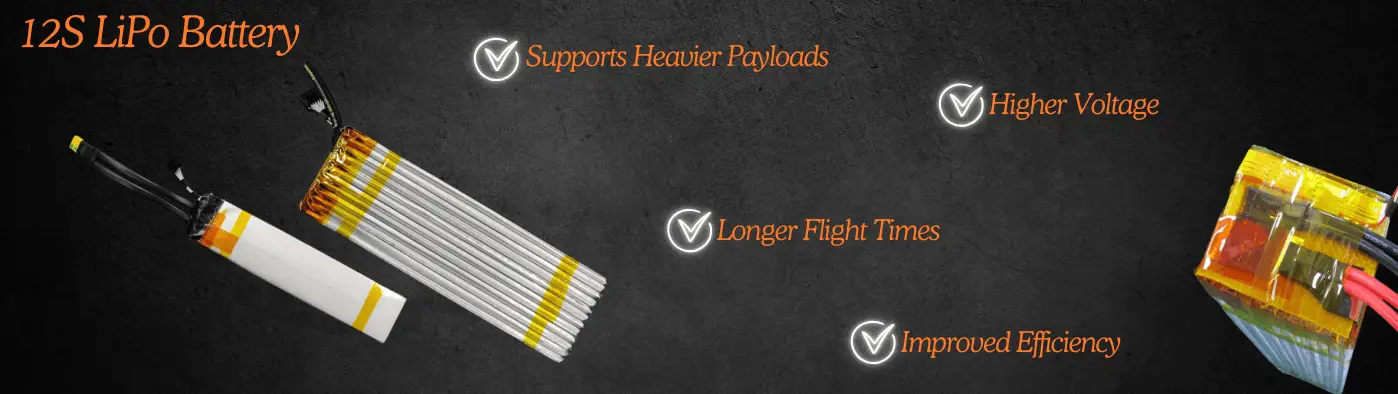
This configuration enables the delivery of the power required for drones to achieve longer flight times and improved performance, thereby aligning with the stringent demands of both recreational and professional drone applications.
12S LiPo Battery
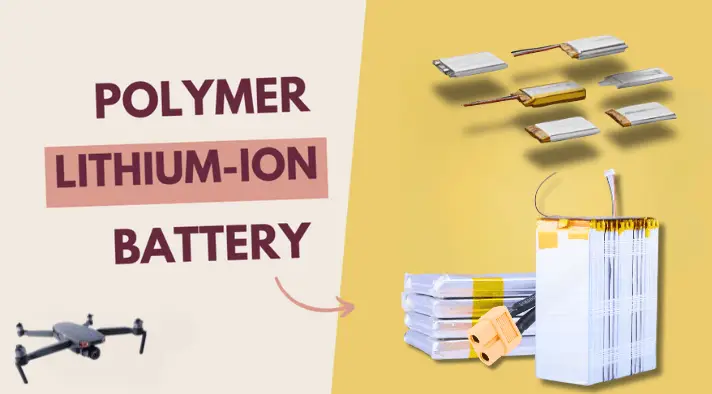
Li-Ion Polymer (12s lipo) batteries, derived from the broader Li-Ion (Lithium-Ion) family, bring forth a lighter and more flexible energy storage solution.
These batteries employ a polymer electrolyte instead of the typical liquid found in other Li-Ion batteries. This shift not only reduces weight but also allows for thinner, flexible, and more varied form factors.