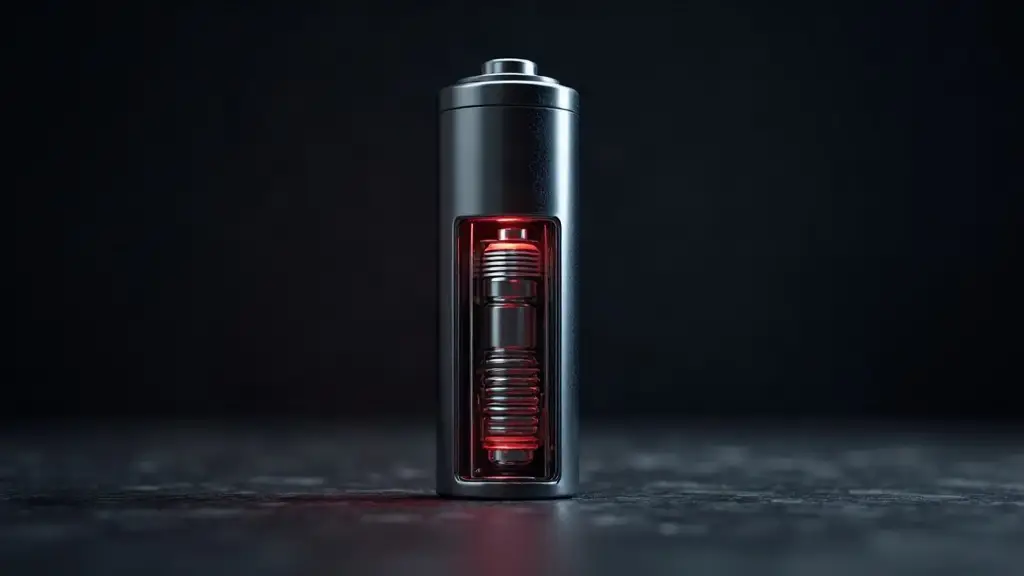
The seesaw between performance, protection, size and cost
Long before the pack designer adds a BMS, fuses, thermal paths, or a clever enclosure, the cell manufacturer has already made the first safety decisions: how much active material, how much mechanical margin, how much current capability, how much internal protection, and how much room to leave for things that do not directly improve the headline Wh/kg.
The Seesaw Starts Inside the Cell
At one end of the seesaw sits the conservative cell: more safety margin, a robust separator, gentler chemistry, tighter operating limits, and sometimes internal safety devices such as PTC, CID and a safety vent. This is the cell that comes to work with a belt, suspenders, a helmet and a first-aid kit. It may not win the beauty contest of energy density, but it is trying very hard to keep everybody calm.
At the other end sits the sporty cell, the Ferrari 296 Speciale of the cell world. More active material, lower resistance, higher current capability, and impressive energy density, provided nobody forgets that it is not an off-road vehicle and not something to hand to a user without instructions. It is fast and attractive, but it needs a good road, a good driver, and proper maintenance. It should not be confused with a Toyota Land Cruiser: less dramatic, perhaps, but still moving when conditions stop being polite.
In simple terms, a Li-Ion cell is not just chemistry. It is an engineering compromise wrapped in a cylinder, pouch or prism.
The Customer Usually Wants Everything
Then the customer arrives. Usually the request is not absurd; it is simply a request for a little more of everything: more energy, more current, more cycles, faster charging, heat, cold, low cost, good availability, and all of that in a smaller and lighter pack.
The problem is that not every requested feature is truly mission-critical. Sometimes a few extra millimeters, a few extra grams, a slightly lower peak current that is rarely used, or a more conservative voltage window can be converted into something very physical: a stronger separator, better spacing between cells, improved heat flow, a safer gas venting path, or simply less stress on the cell.
In other words, the customer may ask for a bit more performance, while the system may actually need a bit more peace of mind. Peace of mind does not always look impressive in a comparison table, but it shows up very clearly when something goes wrong.
What May Be Built Into the Cell?
Many cylindrical Li-Ion cells may include internal safety devices. A PTC increases resistance as temperature rises and can help limit current during abnormal heating. A CID is usually a one-time internal disconnect mechanism activated by excessive internal pressure. A safety vent is intended to release gas and pressure in a more controlled way, reducing the chance of violent rupture.
The words “may include” matter. Not every cell has all these devices, and not every format can use them in the same way. A high-power 18650, a high-energy 21700, a pouch cell, and a prismatic cell are very different mechanical animals. In pouch cells, for example, pressure release is often related to swelling, seals, and the external pack structure rather than a discrete vent in a metal cap.
For the pack designer, the useful question is not only “does the cell have protection?” but: which protection, for which failure mode, at what threshold, and what happens to the rest of the pack when it activates?
PTC, CID and Vent: Useful, But Not Magic
PTC is a perfect example of the seesaw. In a moderate-current cell, it can be an elegant safety layer. In a high-current cell, it may become the security guard who refuses to let the guests into the party. If the application requires high pulses, low resistance, and minimal voltage drop, the manufacturer may choose another architecture or omit such current-limiting elements. That does not automatically make the cell unsafe; it means the pack and system must carry more of the safety work.
CID and vent mechanisms are also important, but they are not normal operating features. If a CID opens or a vent releases gas, the cell has already experienced a serious event. It is like an airbag in a car: excellent to have, but if it opens, the meeting is probably over.
A vent is not a fire-extinguishing system. At pack level, the designer still has to ask where the gas goes, whether it heats neighboring cells, whether the enclosure can breathe, and whether one failed cell can turn into a group activity.
The Separator: The Thin Wall Keeping the Peace
The separator keeps the anode and cathode physically apart while allowing ions to pass. It must withstand manufacturing, vibration, pressure, aging, and temperature while remaining thin enough for good performance.
A thinner separator leaves more room for active material, can reduce resistance, and may improve energy or power. But thinner usually means less mechanical margin and less puncture resistance. A thicker or more robust separator may improve the safety margin, but it takes up space that could have stored energy. The datasheet may prefer the thinner wall; the safety engineer may sleep better with the thicker one.
Some separators include shutdown behavior: at elevated temperature, pores close and ion flow is reduced. This is valuable, but not magical. If temperature continues to rise, the separator can shrink, deform or fail. It is a good wall not a fire department.
Extreme Temperature Claims: Read the Footnotes
Temperature ratings are another area where brochures and engineering sometimes politely disagree. A cell may be approved for discharge over a wide range, while charging is much more restricted. It may survive cold, but not charge safely in cold. It may operate hot, but only with reduced current, reduced lifetime, or an unhappy warranty department.
Whenever a cell “claims” extreme-temperature capability, ask: at what current, at what SOC, for how long, for how many cycles & with what deratings? The headline temperature range is only the invitation. The footnotes are where the bill arrives.
Designing for extremes may require a different electrolyte, separator, operating window and protection concept. Sometimes that costs energy density; sometimes current; sometimes money. Temperature does not negotiate.
What This Means for the Pack Designer
The pack designer must never assume that the cell is already protected in a complete sense. Internal devices are valuable, but they are only one layer. They do not balance a series pack, monitor every hot spot, manage a charger, know the user, or replace fuses, thermal design, mechanical containment and validation.
If a cell was selected for performance and therefore has less internal margin, the pack must pay the bill externally: BMS, fusing, derating, thermal paths, spacing, venting paths and abuse testing. If a conservative cell was selected, the bill may be paid in size, weight, cost or reduced performance. Either way, somebody pays. Good engineering simply decides which currency is cheapest for the mission.
Conclusion
Internal cell safety devices, PTC, CID, vent, separator, gaskets, mechanical structure, and material choices are critical parts of the safety ladder. But they are also part of the compromise. Every micron, milliohm, and cubic millimeter inside the cell reflects a decision: more safety, more energy, more current, lower cost, lower weight, or more risk.
The right question is not only “does the cell have internal protection?” The better question is: what kind of cell is this, what was it designed to do, which protections were built in, which margins were traded for performance, and what must be completed at the pack level?
A safe cell is a good beginning. A high-performance cell is a powerful tool. A good battery pack is built when we understand which side of the seesaw the cell sits on, and avoid pretending it is both a Toyota Land Cruiser and a Ferrari 296 Speciale at the same time.