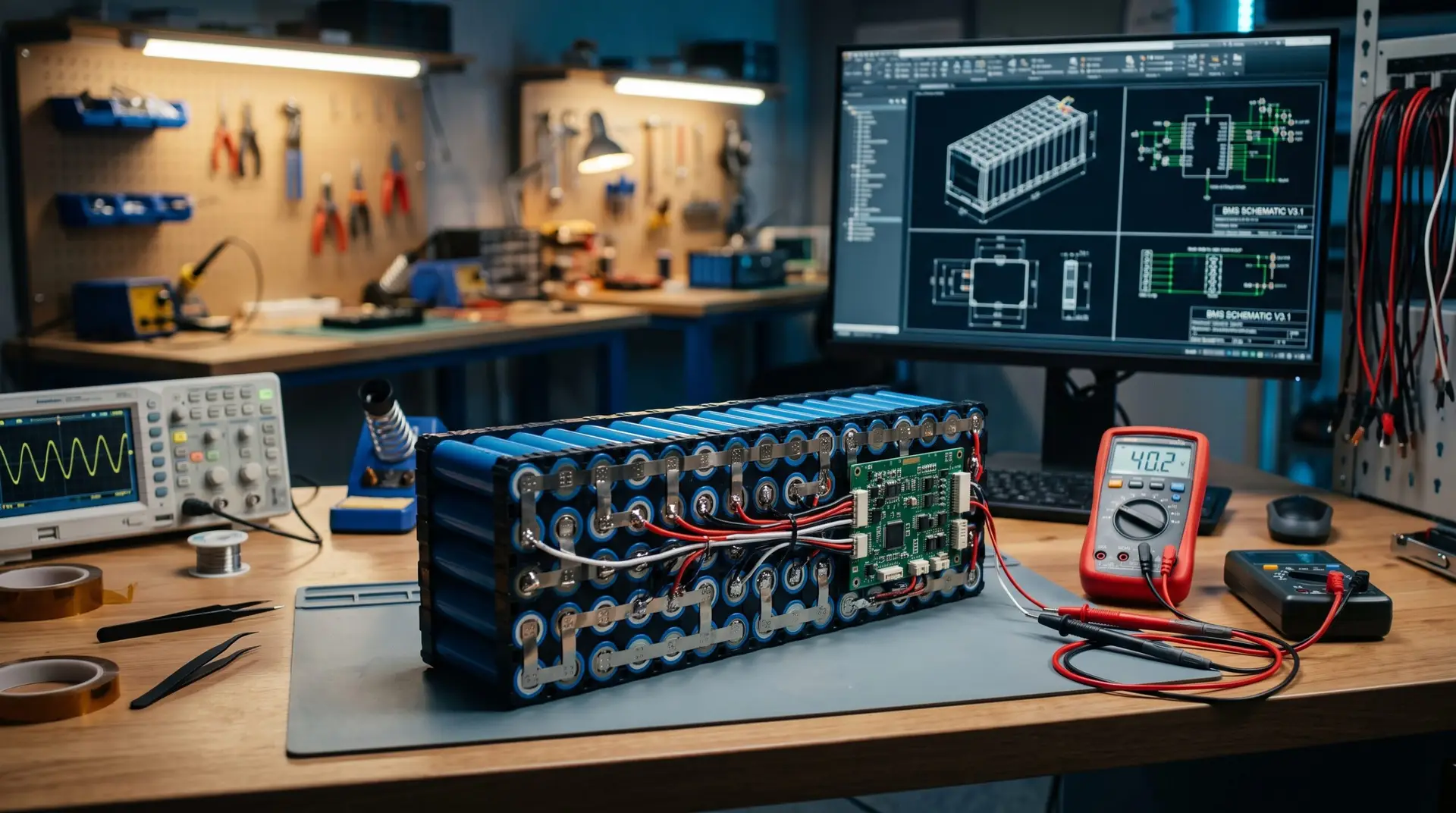
A grounded battery-pack builder’s view with an eye on Li-Ion, manufacturer promises, and the next five years
A few words from the shop floor
The battery world is full of promises & every year brings a new “breakthrough”: five-minute charging, unprecedented safety, energy density that will change your life, and a future that is right around the corner. Sounds wonderful in a presentation (& sometimes it is even true), but anyone who builds battery packs for a living learns a simple rule: between a laboratory cell, a glossy datasheet, and a battery pack that works at a customer’s site, there is a long road and many beautiful numbers fall off the truck along the way.
From the point of view of a battery-pack assembler, the most advanced technology is not the one that made headline but the one you can buy, test, weld, balance, cool, protect, charge, ship to a customer — and still sleep at night.
As of today, when we speak about technology that is truly available for use, the center of gravity is still Li-Ion. Not because new ideas do not exist, but because Li-Ion has already run the real race: suppliers, standards, BMS solutions, chargers, known failures, known fixes, and enough engineers who have seen one or two cells behave differently from the brochure.
First rule: advanced does not mean suitable
When a customer asks which battery is the most advanced, the honest engineering answer is usually: What is your goal?
Believe it or not, but a lot of battery applications today are cost driven. Laptops, cellphones, hobby drones etc. You probably won’t notice if the capacity of your cell phone will be reduced by 10%. So, the most advanced solution will be the cell that cost the best $/Wh.
But when you go to Medical, Defense, and especially manned aerial applications, now you are in the performance driven field.
Medical – you better be safe as hell and very reliable, Defense – long duration, stable under misuse, aerial – light weight, high power and list of qual tests a list that needs its own table of contents.
LFP not the sexiest, often the most useful
Relatively stable, relatively safe, cycle-friendly. Although with lower energy density, for many systems it offers the healthiest compromise between cost, safety, and service life.
For a pack builder, LFP is a chemistry you can work with calmly It is a natural fit for ESS, backup systems, industrial equipment, accessible EV platforms, and applications where weight is not the first enemy.
The drawbacks are clear: Heavier, Bigger. When the customer wants the same runtime, half the weight, the same price, and preferably by tomorrow, LFP lose its charm. In portable or UAV systems, where every gram receives personal attention, it is not always the answer.
NMC / NCA more energy, more responsibility
NMC and NCA offer higher energy density and remain highly relevant where Wh/kg and Wh/L matter: UAVs, portable systems, defense applications, advanced EVs, aviation, and products that need to be powerful, compact and lightweight preferably in defiance of physics.
But real work comes with real rules: High-energy cells demand careful design: smart cell selection, maybe a BMS, thermal management, current testing, temperature testing, mechanical protection, and absolutely no blind faith in the “maximum discharge current” printed in a datasheet.
Manufacturers present numbers measured under friendly conditions: a new cell, controlled temperature and a load profile that may have only a distant family relationship with what the customer will do in the field. In a real battery pack there are welds, busbars, thermal coupling, packaging density, fuses, connectors, BMS losses, and the annoying fact that heat does not disappear just because it was left out of the slide deck.
Silicon anodes real promise, real homework
Silicon-rich anodes are one of the most interesting developments inside the Li-Ion family. The attraction is obvious: silicon can store much more lithium than graphite & improve energy density. For system engineers, that sounds like a gift: more energy in the same mass.
There is, of course, an asterisk. Silicon expands and contracts significantly during cycling (swelling). In other words, you need a strong case (of course with required with the weight of Helium). Manufacturers are improving this with advanced materials, structures, and processes, and impressive commercial cells already exist, especially for UAVs, aviation, and high-end applications.
From a pack builder’s point of view, this is exciting but not something to adopt with closed eyes. Real cycle life, swelling, temperature behavior, fast-charge tolerance, calendar aging, storage sensitivity, and mechanical integration all need to be checked. Silicon brings muscle, but you still have to make sure it does not tear the shirt.
Fast charging is beautiful in advertising, difficult in reality
Fast charging is one of the most attractive promises in the market. Nobody wants to wait — not EV drivers, not soldiers, not drone operators, and certainly not someone holding a tool with a dead battery five minutes before the job ends.
But think about the procedure – If you need fast charge that probably means you just empty the battery you use. What is its initial temperature when you plug it to a fast charger? And if you succeeded to fast charge, what will be the battery initial temperature in the second round of discharge? EV batteries have volume to include internal cooling (or at least heat dissipation). Do you?
What about accelerated aging & cell balance? and what will happen after 200 cycles, on a hot day, inside a tight enclosure?
Fast charging is possible & improve quickly. But nothing is free.
Sodium-Ion is interesting, but not for tomorrow
Sodium-Ion is a fascinating direction. It uses more abundant raw materials, may offer useful safety and low-temperature advantages, and could be very attractive where cost, supply-chain resilience, and cold performance matter more than maximum energy density.
For a pack builder, however, Sodium-Ion is not yet a simple “replace Li-Ion and move on” solution. Energy density is generally lower, the supply chain is less mature, field history is shorter, and there are fewer proven chargers, BMS solutions and application lessons than in the Li-Ion world.
It may become very important in ESS, backup systems, urban mobility, and applications where volume and weight are less critical. But in high-energy portable systems, UAVs, and lightweight defense products, it still has to prove it can survive the service.
Solid-State is the future, but not every future arrives on Monday morning
Solid-state batteries are the star of conferences. They promise better safety, higher energy density, and the possibility of lithium-metal anodes. On paper, this sounds like the battery we all ordered.
In practice, anyone building packs for customers asks less romantic questions: Can we buy it in quantity? What is the price? What is the real cycle life? What happens at low temperature? How does it behave under vibration? How sensitive is the manufacturing process? How do we connect it? How do we test it? Who provides warranty? And is there a human being available when something strange happens?
Solid-state technology is progressing and will probably appear in premium, automotive, aviation, or special applications over the coming years. But today it is still not a broad off-the-shelf replacement for conventional Li-Ion in most applications. In simple terms: it is the future, but the future has not yet passed enough incoming inspection.
What really happens inside a pack?
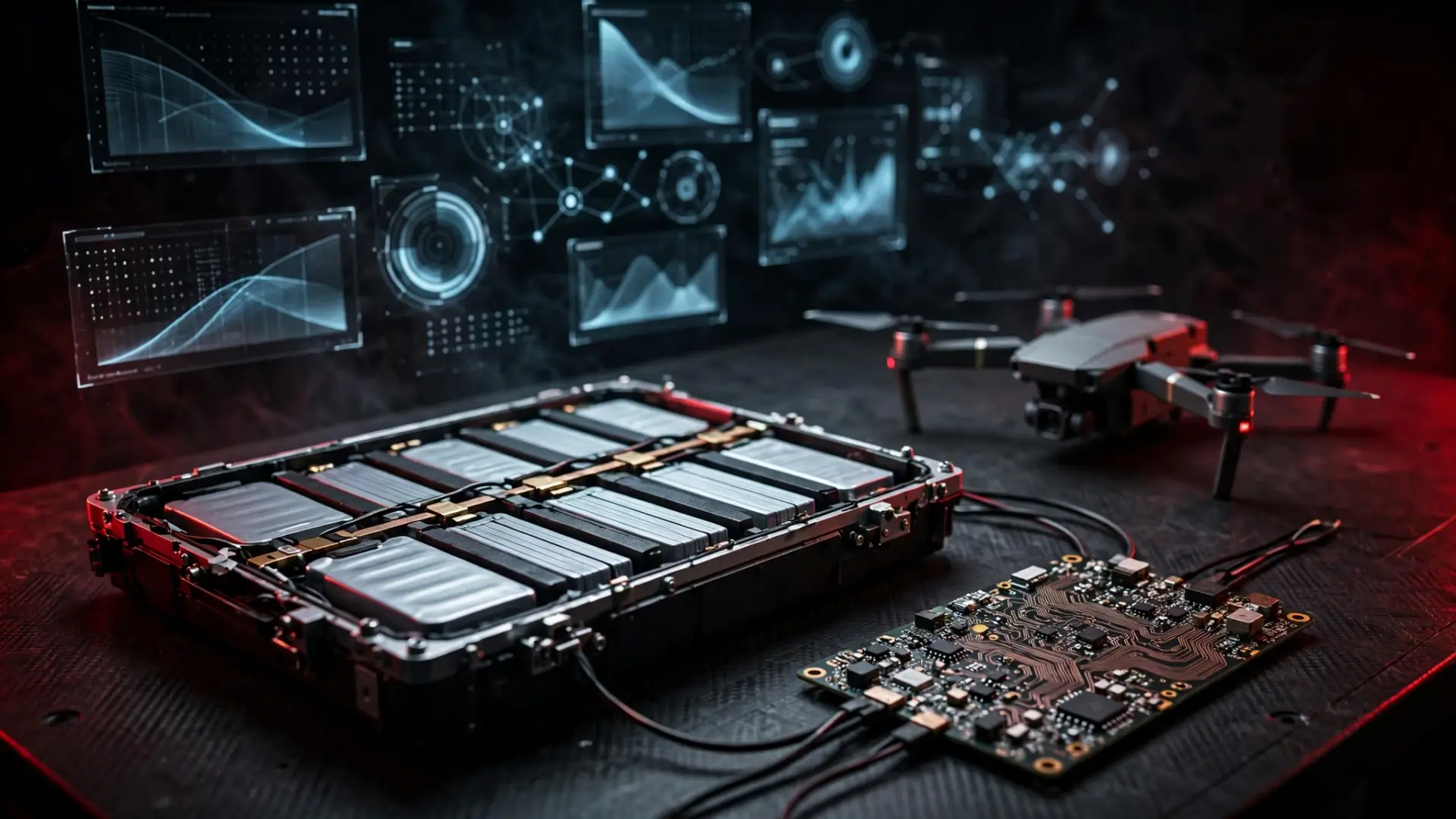
A common mistake is to look at a single cell and assume the battery pack will behave the same way. It will not. A cell has manufacturer data. A pack has welds, busbars, added resistance, thermal coupling, fuses, BMS or PCM, connectors, enclosure, sealing, vibration, drops, storage, and a real end user.
Each of these items eats a little performance. Sometimes a little, sometimes a lot. So when a cell maker shows an impressive number, the pack builder does not ask only “how much?” but also “under what conditions?”, “for how long?”, “at what temperature?”, “after how many cycles?”, “inside what enclosure?”, and “is this still true after we put it into the box the customer designed before speaking with us?”
The next five years: evolution, not magic
Over the next five years, we should expect strong evolution rather than one magic battery that replaces everything. LFP will continue to grow in ESS, backup, industry, and accessible EVs. NMC and NCA will remain important wherever weight and volume decide whether the product works. Silicon-rich anodes will enter more products, not everywhere and not without limits, but as one of the most practical ways to improve Li-Ion without throwing away the entire manufacturing world.
Fast charging will improve, but it will require full system design: cell, BMS, charger, cooling, charge algorithm, and real testing. Sodium-Ion will find its place where cost, raw materials, and safety matter more than top energy density. Solid-state will begin to appear in pilots, premium products, and special applications, but it is unlikely to conquer the entire market immediately.
So what is the most advanced technology today?
From the point of view of a battery-pack builder, the most advanced technology is not necessarily the one with the highest Wh/kg or with the highest Discharge rate. It is the technology that provides the right balance of performance, availability, safety, cost, reliability, manufacturability, testability, warranty risk, and field experience.
Sometimes that is LFP. Sometimes it is NMC. Sometimes it is LTO. Sometimes it is a silicon-rich high-energy cell and sometimes we tell the potential customer: “We know a start-up designing what he want and come back in 3 years…”
Conclusion
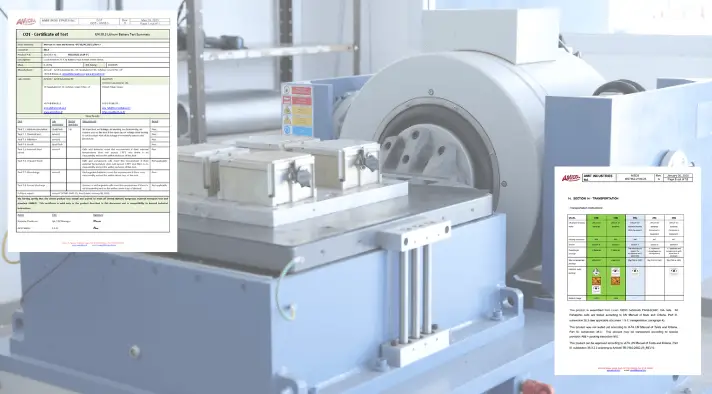
A modern battery is no longer just an energy source. It is a full engineering system: chemistry, mechanics, thermals, electronics, software, safety, manufacturing, and responsibility. New technologies are fascinating, and some of them are already changing the market. But between a promise and a reliable pack there is one very important layer: testing.
A good battery-pack builder does not get excited by every announcement, but also does not dismiss new technology. He tests, compares, asks uncomfortable questions, applies safety margins, builds prototypes, runs cycles, heats, cools, opens, inspects, and sometimes says the sentence the customer least wants to hear: “It is possible, but not under these conditions.”
In the coming five years, batteries will become better, cheaper, faster-charging, and in many cases safer. But we are unlikely to see one battery that wins every parameter. The battery world will remain a toolbox: every job needs the right tool.
And in the end, the most important question is not: What does the manufacturer promise? It is: What will the battery pack do after that promise is welded, packed, heated, aged, dropped once from the bench — and delivered to a real customer on a hot day?